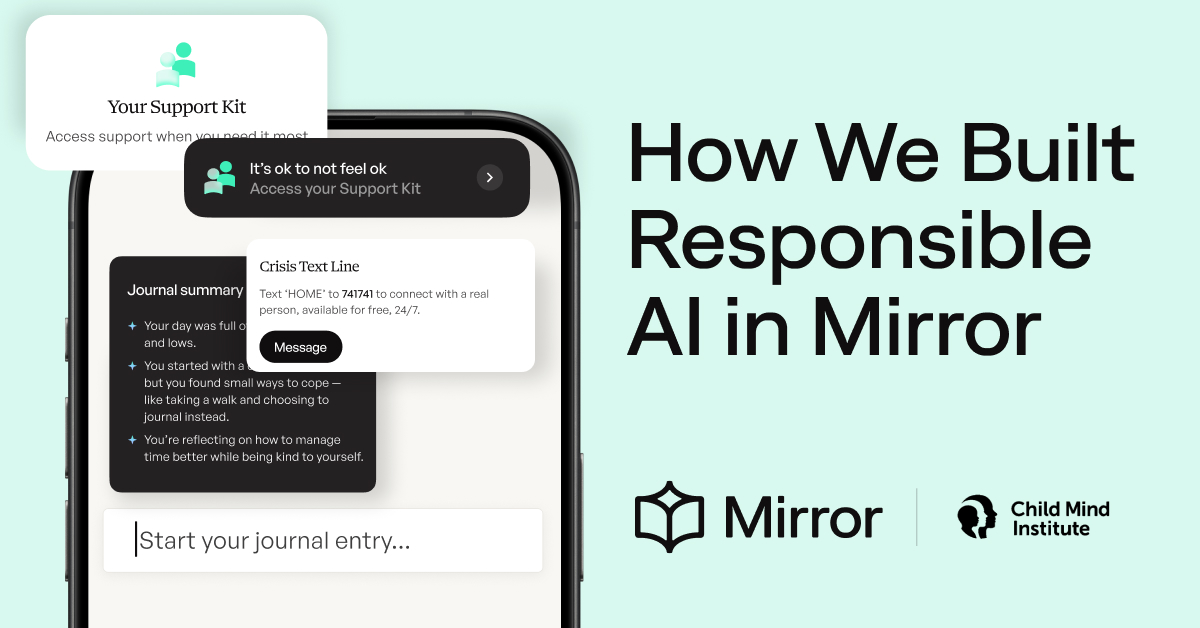
# How the Child Mind Institute Built Ethics Into Its AI Journaling App
The Child Mind Institute has launched Mirror, a digital journaling tool that treats artificial intelligence as a tool for human connection rather than a replacement for it. The developers faced a core ethical challenge: when young people share vulnerable thoughts with an algorithm, how does technology responsibly support their mental health?
Mirror represents a deliberate shift in how tech companies approach mental health apps. Instead of positioning AI as a therapist substitute, the creators designed the tool to encourage users toward meaningful conversations with actual people in their lives. The journal entries young people write become a starting point for deeper human relationships, not an endpoint where an algorithm claims to "help."
This philosophy matters because teenagers and children increasingly turn to digital tools during mental health struggles. Research shows that while journaling itself has documented benefits for emotional processing, the relationship with another human being remains irreplaceable in mental health care. The Child Mind Institute, a respected nonprofit research organization focused on child mental health, recognized this gap.
The development process centered on responsible AI principles. The team built safeguards that prioritize user safety while respecting privacy. Rather than collecting data to train broader AI systems, Mirror keeps individual journals private. The AI features work to help users articulate their feelings more clearly, not to diagnose or treat mental health conditions.
Parents using Mirror with their children gain a tool that supports honest reflection without replacing family conversations or professional help when needed. The app acknowledges its own limitations. It doesn't promise to "fix" depression or anxiety. Instead, it creates space for vulnerable expression and encourages the kind of openness that strengthens family relationships and prepares young people to seek professional support when appropriate.
This approach reflects growing recognition that mental health tech serves young people best when it stays in its lane. The most responsible AI in this space supports human connection rather than competing with it.