# Why Most Probiotics Don't Work for Women (And What Actually Does)
Your medicine cabinet is probably full of empty probiotic bottles. You bought them for better digestion, clearer skin, or a steadier mood. Nothing happened. Now you're wondering if probiotics work at all.
The answer is complicated. Probiotics can work. But most products on store shelves won't work for you, because they weren't designed with women's bodies in mind.
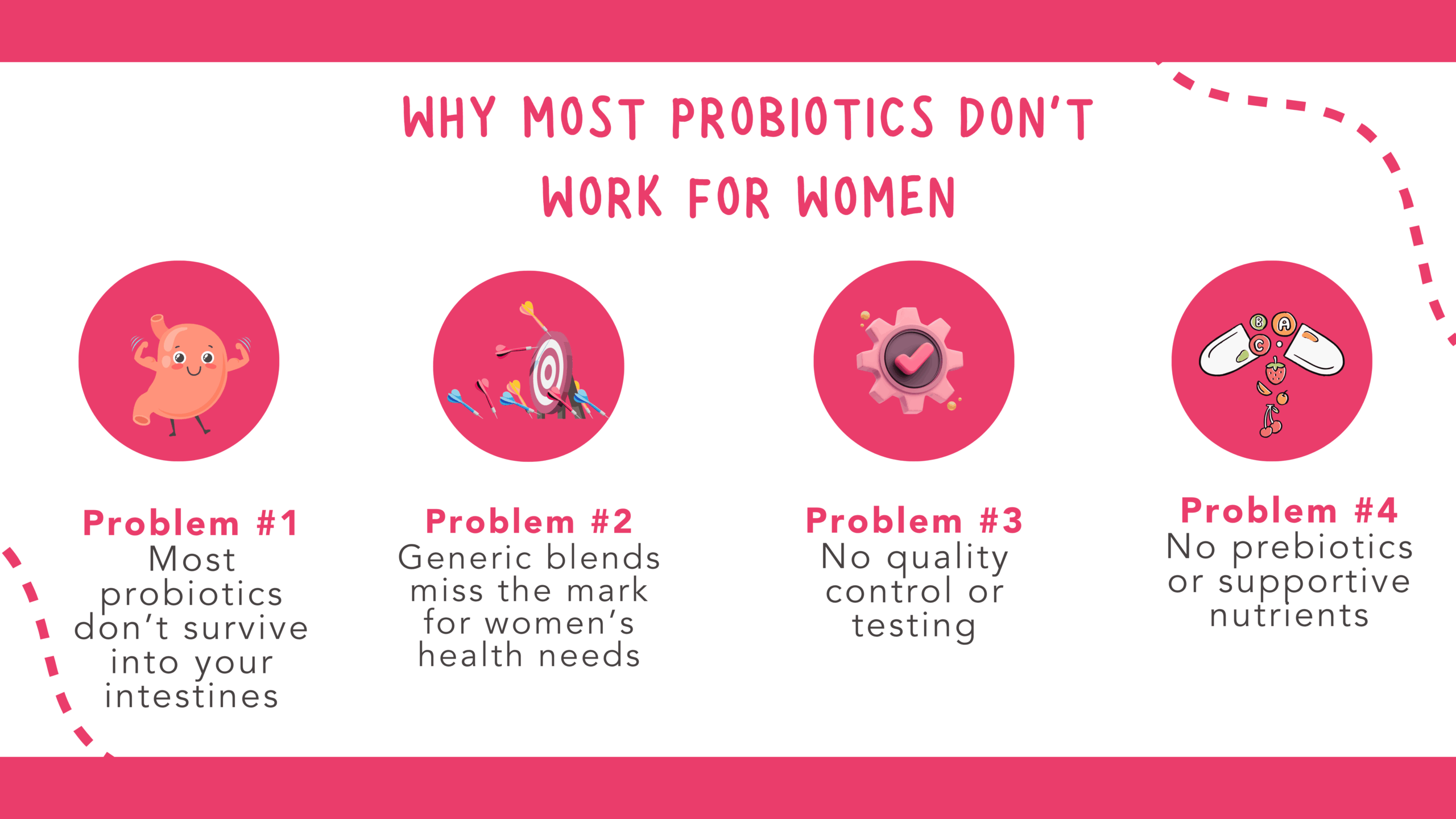
Here's what research actually shows about probiotics and women. The gut microbiome differs significantly between men and women. Women have different bacterial populations, hormone cycles that affect digestion, and distinct health concerns like yeast infections and urinary tract infections. Yet most probiotic formulas ignore these differences entirely. They're generic blends marketed to everyone equally.
The first problem is strain selection. Not all probiotic strains do the same thing. Lactobacillus rhamnosus GR-1 has research supporting its use for vaginal and urinary health in women. Lactobacillus crispatus supports vaginal microbiome balance. But walk into any drugstore and you'll find probiotics containing Bacillus coagulans or Saccharomyces boulardii, strains chosen for cost and shelf stability rather than clinical evidence for women's health.
The second problem is dose and potency. Many over-the-counter probiotics contain far fewer live organisms than the research suggests. A study published in the journal Nutrients found that many products contain only a fraction of their claimed CFU count (colony-forming units, the measure of live bacteria). Some lose potency before the expiration date even arrives. Women need enough viable bacteria to actually colonize the gut and vaginal tract, not just a symbolic amount.
The third problem is delivery. Most probiotics die in stomach acid before reaching the intestines where they can help. Enteric coating protects some strains, but not all products use it. Others use cheap fillers that don't preserve the bacteria during storage or shipping.
So what actually works? Look for products specifically formulated for women's health. Brands like Culturelle Her, Probulin Women's Complete, and Seed's Synbiotic+ have published research behind their formulations. Culturelle Her contains Lactobacillus rhamnosus GR-1, tested specifically for women. It also uses enteric coating and maintains stable CFU counts through expiration.
Check the label for these specifics: named strains (not just "Lactobacillus blend"), minimum 25 billion CFU per dose, enteric coating, and third-party testing by organizations like NSF International. Buy from sources that guarantee refrigeration, since heat and moisture destroy probiotics quickly.
Talk with your doctor or a registered dietitian about whether you need probiotics at all. Food sources like yogurt, kefir, sauerkraut, and kimchi provide live bacteria without the marketing hype. If you choose a supplement, give it at least 4-8 weeks before deciding whether it works. Your microbiome changes slowly.
The probiotic industry markets aggressively to women, promising miracles that most products can't deliver. That doesn't mean probiotics are worthless. It means women deserve products actually designed for their biology, not afterthoughts packaged in pretty bottles.